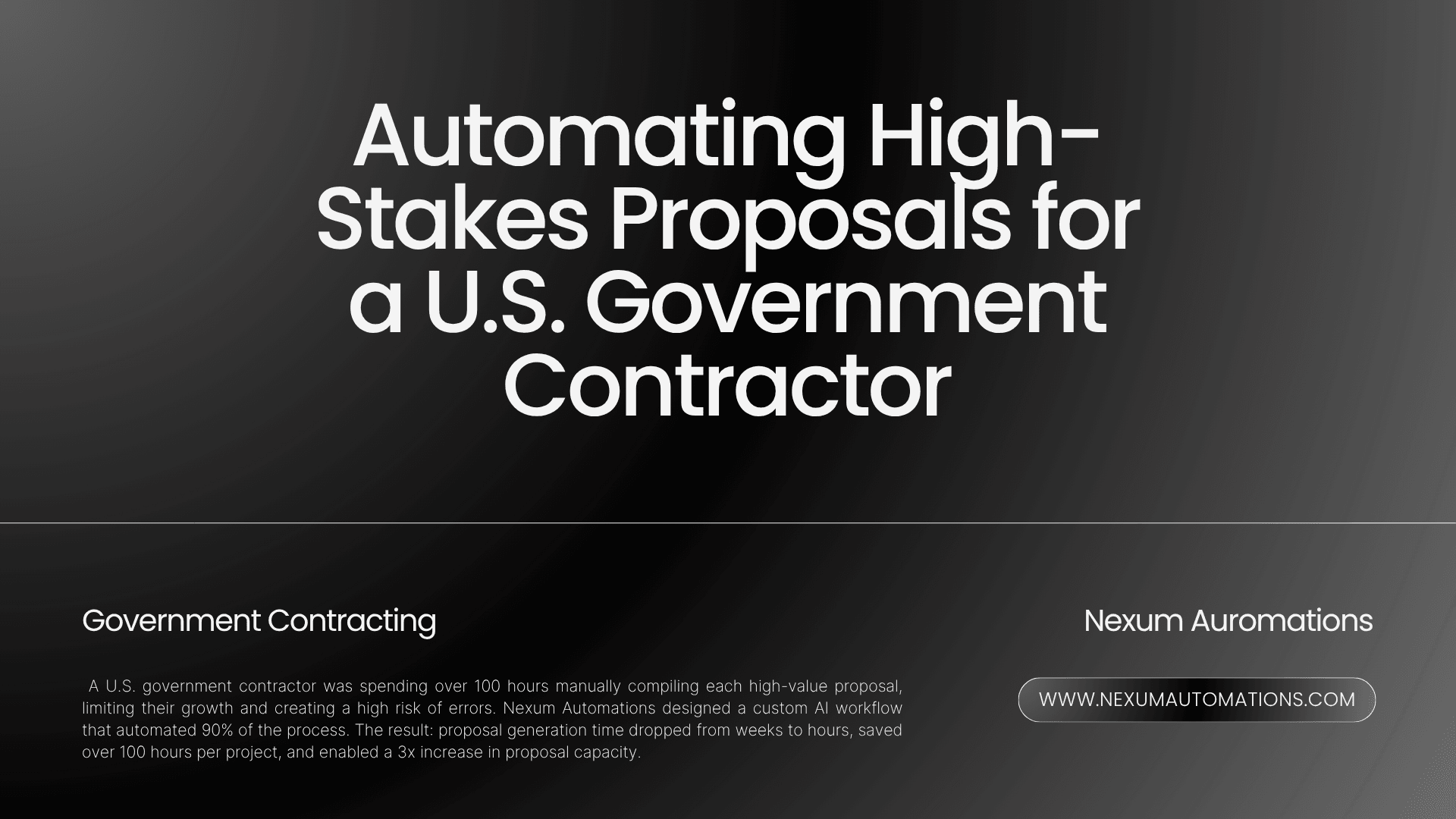
TL;DR: AI RFP automation reduces government proposal writing from 200 hours to 18 hours without sacrificing compliance or win rate. Contractors using AI tools submit 3-5x more proposals annually.
Government Contracting in the AI Era: How to Automate RFP Responses Without Losing Quality
Reading time: 14 minutes
Introduction: The 200-Hour Problem
A mid-size defense contractor came to us drowning in proposals:
- 40-60 RFPs/year in pipeline
- 5-person proposal team working 60-hour weeks
- 180-220 hours per proposal
- Capacity: 15 proposals/year (declining ~70% of qualified opportunities)
- Win rate: 18% (industry 15-20%)
- Cost/proposal: $18,000-25,000 in labor
The math was brutal: they could only pursue 15 of 55 qualified opportunities—leaving $340M in potential contract value on the table.
We implemented an AI proposal automation system. Six months later:
- 90% reduction in manual work
- 100+ hours saved/proposal (200 → 18 hours)
- 3x proposal capacity (15 → 45/year)
- Win rate maintained at 18%
- $4.6M additional contract wins in year one
The RFP Bottleneck: Why Contractors Can't Scale
The Brutal Economics of Proposal Development
Complexity: 50-500 pages of requirements; 200+ line-item compliance matrices; past performance; technical and management volumes; pricing packs with detailed breakdowns.
Time investment: Small: 80-120 hours; Medium: 150-250 hours; Large: 300-600 hours.
Labor cost: Proposal manager $85-125/hr; Tech writers $65-95/hr; SMEs $95-175/hr; Graphics $55-85/hr → $15,000-60,000 per proposal.
The Opportunity Cost Crisis
Most contractors can pursue only 20-30% of qualified RFPs.
- Qualified: 55/year
- Capacity: 15
- Declined: 40 (~73%)
- Avg contract: $8.5M
- Potential value declined: $340M
- Win rate: 18%
- Missed value: $61.2M/year
The bottleneck isn't opportunity—it's proposal capacity.
Why This Is Getting Worse
- Rising volume: $700B+ federal spend; more rapid acquisitions; more MACs
- Shorter windows: 45 days (2015) → 21 days (2025); some 7-10 days
- Labor inflation: proposal salaries up 22%; SME scarcity
- Compliance complexity: CMMC 2.0, cybersecurity attestations, SCRM, past performance depth
Traditional approach doesn't scale. AI automation does.
What Can (and Can't) Be Automated
✅ Fully Automatable (90-95% AI, 5-10% Review)
- Boilerplate: company overview, facilities, QA systems, bios, corporate experience (save 20-30 hours)
- Compliance matrices: extraction, cross-reference, verification, gap ID (15-25 hours)
- Document assembly & formatting: compile from library, apply gov standards, TOC, cross-references (10-15 hours)
- Past performance narratives: database-driven summaries, CPARS, refs (12-18 hours)
⚠️ AI-Assisted (50-70% AI, 30-50% Human)
- Technical approach (non-differentiated): methods, best practices, regulatory frameworks (25-40 hours)
- Management approach: org charts, comms, QA, schedule (15-25 hours)
- Transition plans: phase-in, knowledge transfer (8-12 hours)
❌ Human-Led (AI Supports)
- Win strategy & themes: differentiators, proof points
- Innovative solutions: novel technical designs
- Pricing strategy: PTW, modeling, final decisions
Net: Traditional ~200 hours → With AI ~15-25 human hours (87-92% reduction).
Case Study: 90% Reduction in Manual Work
The Contractor
- 500 employees; IT, cyber, systems integration; $3M-$15M awards; $180M revenue
The Challenge
Team: 1 PM, 2 writers, 1 graphics, 1 coordinator; SMEs pulled 10-40 hours/proposal.
Capacity: 15-18 proposals/year; 55-60 evaluated; 70-75% declined; 18% win rate; ~3 wins/year.
Pain: burn-out; 30% turnover; inconsistent quality; shrinking SME availability.
The Solution: AI Proposal Automation
Phase 1 (Weeks 1-2): Build content library—past performance (450), boilerplate (85), technical templates (120), management templates (65), bios (200+), graphics (1,200+).
Phase 2 (Weeks 3-4): AI integration—requirement extraction, auto compliance matrices, content assembly, quality checks, formatting engine.
Phase 3 (Weeks 5-6): Workflow redesign—AI extracts requirements (2h → 15m), generates matrix (20h → 2h), assembles first draft (40h → 4h); PM review (8h); writers customize (6-8h); SME review (4-6h); AI final formatting (8h → 1h). Total: 18-22 hours.
Results (12 Months)
| Metric | Before | After | Change |
|---|---|---|---|
| Hours/proposal | 200 | 18 | -91% |
| Proposals/year | 15 | 48 | 3.2x |
| Overtime | 60-70 hrs | 40-45 hrs | Normalized |
| Decline rate | 73% | 20% | ↓ |
| Win rate | 18% | 18% | Maintained |
| Compliance errors | 3-5 | 0-1 | -80-100% |
| Formatting errors | 8-12 | 0-2 | -83-100% |
| Annual contract wins | $23M | $73M | +$50M |
ROI: $85K invest; +$50M awards; 12% margin → $6M profit → 70x in year one.
Key insight: AI eliminates the tedious 90%, freeing humans to focus on the strategic 10% that wins.
The AI Proposal Automation Stack
1) Document Intelligence Engine
Extracts requirements; classifies; builds draft compliance matrix. Time saved: 15-20 hours. Cost: $500-1,500/mo.
2) Content Library & Management
Reusable past performance, boilerplate, win themes; semantic search; approvals; performance analytics. Save: 25-35 hours. Cost: $300-800/mo.
3) Content Assembly Engine
Auto-match requirements to content; generate first draft; apply gov formatting. Save: 30-45 hours. Cost: $800-2,000/mo.
4) Compliance Verification
Trace every requirement; gap analysis; page limits; validation. Save: 12-18 hours. Cost: $400-1,000/mo.
5) Human Review & Strategy
PM review; writer customization; SME validation; leadership sign-off. Time: 15-25 hours—where humans add value AI can’t.
Total System Cost
SaaS: $34K-80K year 1; $24K-60K/year ongoing. Custom: $110K-220K year 1; $15K-30K/year maintenance.
Implementation Roadmap: 8-Week Plan
Weeks 1-2: Foundation & Content Audit
- Audit proposal library; catalog wins/losses
- Build past performance DB; create boilerplate templates
- Identify gaps; define win themes per offering
Weeks 3-4: AI & Integrations
- Deploy requirement extraction & compliance engine
- Integrate content library; set approval workflows
- Configure formatting engine to agency standards
Weeks 5-6: Pilot & Workflow Redesign
- Run 2-3 live RFP pilots; time every step
- Redesign workflow to AI-first; define RACI
- Train PMs/writers/SMEs; measure quality impact
Weeks 7-8: Scale & Optimize
- Roll out to all RFPs; add content coverage for gaps
- Establish proposal performance analytics (win rates by section/theme)
- Quarterly library refresh; continuous improvement loop
Final Takeaway
AI doesn’t replace proposal strategy—it amplifies it. By automating the repetitive 90%, you multiply capacity, protect quality, and convert more qualified opportunities into wins—without burning out your team.
For contractors that want this built for them rather than assembled in-house, that is custom AI development for government contractors: a done-for-you system that automates RFP and proposal workflows end to end.